
Epoxy lab Slabs
Epoxy lab slabs feature premium solid panel construction through one-piece integral pouring and hardening processes. Manufacturers craft these chemical resistant lab worktops with high-purity epoxy resin, fine quartz fillers and eco-friendly curing agents.
Overall, the formula delivers a uniform compact structure and stable physicochemical properties that fit professional lab environments perfectly. Unlike ordinary layered composite boards, these panels hold zero internal delamination or hollow gaps.
Therefore, they provide reliable tabletop solutions for standard laboratories, chemical workshops, pharmaceutical labs and dust-free clean room workstations.
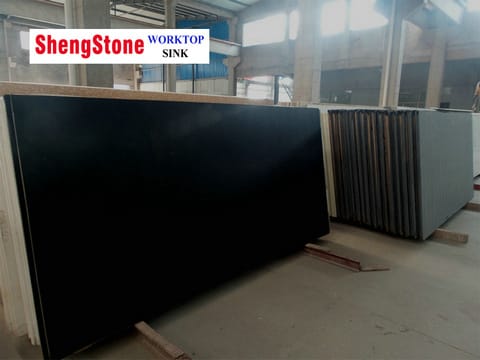
Standard Specifications & Colors
Size & Thickness Options
Epoxy lab slabs support diverse engineering and lab renovation needs with two standard panel sizes: 1600×3200mm and 1200×2400mm. Meanwhile, users can select 16mm, 19mm and 25mm thicknesses for heavy-duty lab bench applications.
Available Color Selection
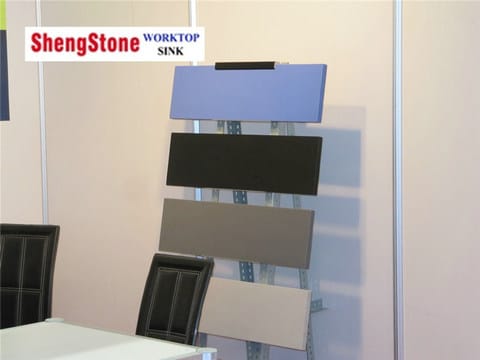
We supply four mainstream colors: black, grey, light blue and pure white. In particular, the dense molecular structure enables these panels to outperform granite, phenolic boards and ceramic boards in flatness and durability.
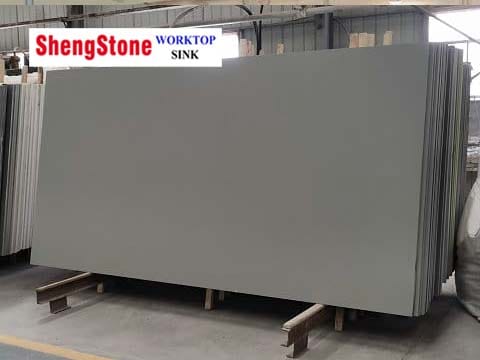
As a result, they deliver superior corrosion resistance, fully suitable for diverse industrial testing and scientific research laboratory scenarios.
Professional Production Process
Precision Batching & Vacuum Molding
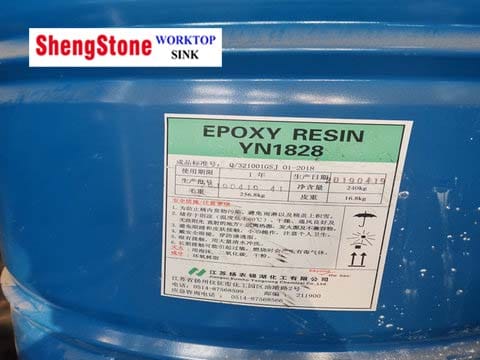
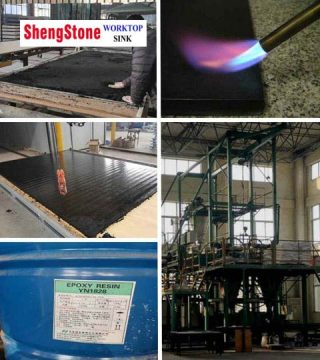
To guarantee consistent quality, our team adopts precise material proportioning and one-piece pouring in a constant-temperature dust-free workshop. Workers blend modified epoxy resin, quartz sand and functional additives, and fully eliminate internal air bubbles.
After thorough mixing, they inject the homogeneous mixture into custom molds strictly, ensuring stable and consistent quality for solid epoxy bench panels per batch.
Staged Curing & Molecular Crosslinking
Epoxy lab slabs adopt segmented low-temperature hardening, long-duration constant-temperature baking and natural curing for complete epoxy resin molecular crosslinking.
Through this systematic treatment, this process forms a stable 3D network structure with no adhesive layers or surface coatings, achieving uniform texture from surface to core.
Integrated Defect-Free Structure
Benefiting from this advanced manufacturing method, it effectively avoids common panel defects such as delamination, bulging, cracking and liquid penetration.
Furthermore, it maintains complete structural integrity and ensures long-term structural stability for daily laboratory testing operations.
Epoxy Lab Slabs Structural & Environmental Advantages
Ultra-Low Water Absorption & Stable Composition
Different from traditional composite panels, these panels contain no fiberglass or paper substrates and maintain an ultra-low water absorption rate below 0.02%.
For this reason, they deliver stable and reliable performance in humid, sterile, high-temperature and heavily corrosive lab working environments.
Excellent Chemical Corrosion Resistance
Epoxy lab slabs own outstanding anti-corrosion capability, the core advantage for acid and alkali resistant lab worktop applications. In general, fully cured panels retain stable chemical properties.
Specifically, they can effectively resist damage from strong acids, strong alkalis, organic solvents and strong oxidizing substances.
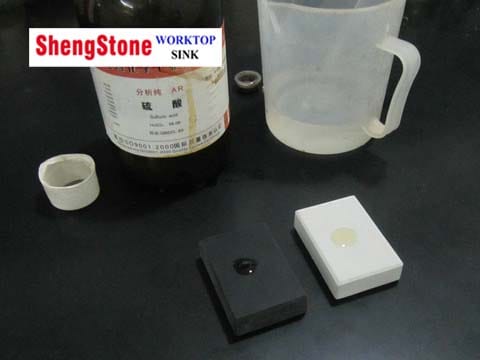
Even under extreme conditions, in extreme 24-hour corrosion tests, surface contact with corrosive liquids causes no whitening or pitting after simple wiping.
Hence, no residual stains remain on the surface, making the panels ideal for chemical analysis and pharmaceutical testing labs.
Medical-Grade Hygiene & NSF Food Safety
Thanks to its unique material characteristics, the non-porous compact surface inhibits bacterial and mold growth and leaves no cleaning residue after wiping.
Accordingly, it fully meets CDC and medical laboratory hygiene standards, and qualified products pass NSF food-grade certification for food safety inspection workbenches.
High Heat Resistance & UL94-V0 Flame Retardancy
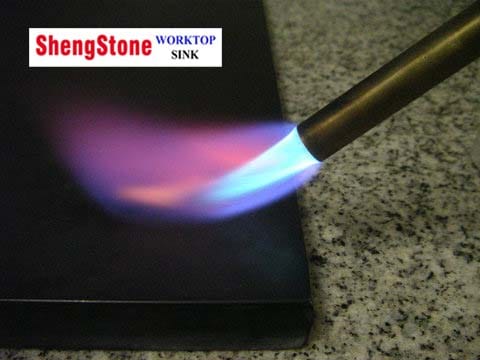
Apart from corrosion resistance, these panels feature outstanding heat resistance, flame retardancy and mechanical stability. They withstand continuous 130℃ working temperatures and short-term 600℃ open fire.
In turn, they produce no bubbles, cracks or harmful gases, fully complying with UL94-V0 fire safety standards for high-temperature lab operation.
Superior Mechanical Performance & Long Lifespan
With Rockwell hardness over 100, these panels resist compression, bending and impact damage to prevent edge breakage and surface cracks.
In addition, users can easily polish out minor daily scratches, and the panels offer over 15 years of stable service life.
Ultimately, they greatly reduce long-term laboratory maintenance and replacement costs for laboratory construction projects.
Surface Design & Customization Service
Matte Anti-Glare & Anti-Slip Surface
To optimize lab operating experience, the professional matte surface effectively reduces strong light reflection and delivers clear visual observation during delicate lab experiments.
Meanwhile, the built-in anti-slip texture greatly improves operational safety for daily laboratory work and precision experiment procedures.
Personalized Processing Options
Epoxy lab slabs support customized round corners and 45° bevel edges to match custom-built lab central tables, side tables and laboratory reagent shelves.
On this basis, our flexible customization supports full-project personalized solutions for all kinds of commercial laboratory renovation projects.
Wide Application Scenarios
Industrial, Medical & Research Lab Use
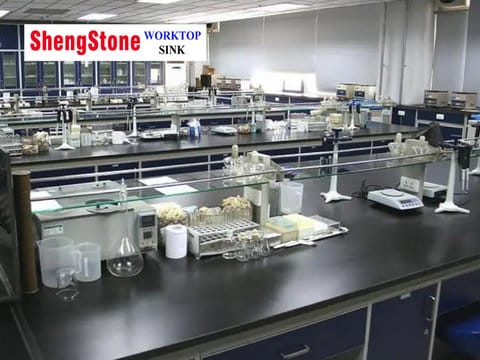
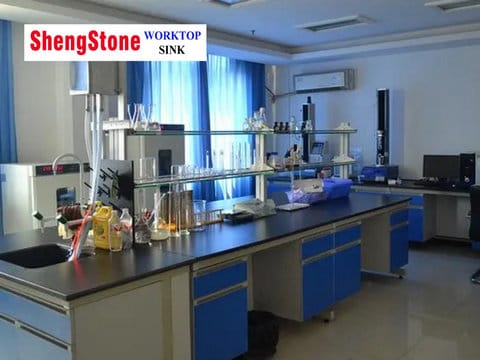
In practical application, these durable panels suit anti-corrosion workstations in chemical factories and electroplating workshops, and testing benches in hospital laboratories.
Besides these scenarios, they also serve training platforms in university research centers, plus cleanroom tabletops for semiconductor and microelectronics clean workshops.
Advantages Over Traditional Lab Materials
Comprehensive Performance Comparison
Epoxy lab slabs outperform traditional lab tabletop materials with zero radioactive substances and seamless splicing work surface to avoid dirt accumulation.
Comparatively, they offer better acid and alkali resistance than phenolic boards and stay stable in humid environments.
Unlike rigid ceramic boards, they allow flexible on-site cutting and drilling for neat and efficient lab installation.
Industry Trends & Market Outlook
Technical Upgrading & Product Iteration
Currently, evolving laboratory construction standards drive continuous product optimization. We develop anti-static and UV-resistant epoxy panels for special industrial conditions.
Meanwhile, upgraded domestic manufacturing technology creates high-stability, cost-effective products meeting international laboratory safety standards.
Growing Market Demand & Future Potential
Epoxy lab slabs gain rising market demand from booming standardized laboratories and cleanroom engineering projects. Furthermore, continuous technical improvements further enhance product stability.
FAQ
1. What are epoxy lab slabs?
Epoxy lab slabs are high-performance solid countertop materials made of high-purity epoxy resin, quartz fillers and eco-friendly curing agents through integral one-piece casting and closed curing. Featuring uniform solid structure, zero delamination and low water absorption, they are specially customized for professional laboratory and industrial anti-corrosion scenarios.
2. What are the core advantages of epoxy slabs?
These slabs own outstanding comprehensive performance. They resist strong acid, alkali and various organic solvent corrosion, support long-term high-temperature resistance and reach UL94-V0 flame retardant grade. Besides, their non-porous surface prevents bacterial growth, with high hardness, polishable scratches and a service life of more than 15 years.
3. Are lab epoxy slabs suitable for humid and sterile environments?
Yes, they are completely applicable. Without glass fiber or paper substrates, lab grade epoxy slabs have a water absorption rate lower than 0.02%. The dense and seamless structure avoids moisture penetration and mildew breeding, maintaining stable physical and chemical performance in humid, sterile and other harsh environments.
4. Can high-temperature equipment be placed directly on the slabs?
Absolutely. The slabs can withstand a long-term working temperature of 130℃ and instantaneous 600℃ open flame exposure. Common laboratory equipment such as alcohol lamps and high-temperature electric furnaces can be directly placed on the surface without blistering, cracking or harmful substance volatilization.
5. How do lab epoxy slabs differ from traditional granite and phenolic panels?
Compared with granite, they have no radioactive substances and seamless splicing to avoid dirt accumulation. Different from phenolic panels, they never deform in humid conditions and have far stronger corrosion resistance. Meanwhile, they support on-site cutting and drilling with easier construction than ceramic countertops.
6. What scenarios can lab epoxy slabs be applied to?
They cover multiple professional scenarios, including chemical analysis laboratories, medical and CDC laboratories, food inspection platforms, university scientific research benches, chemical plant anti-corrosion workstations, electroplating workshops, as well as semiconductor and microelectronics cleanrooms.
7. Can scratches on the slab surface be repaired?
Yes. Lab grade epoxy slabs have excellent restorability. Fine scratches generated during daily use can be easily polished and repaired manually. Regular maintenance can effectively extend the service life and keep the surface flat and smooth for long-term use.
8. Are the slabs customizable for different usage needs?
Yes. The slabs support personalized processing, including customized specifications of conventional thickness and size, as well as edge treatments such as round corners and 45° chamfers. They can be perfectly matched with central experiment tables, side tables and reagent racks for integrated customized design.